Release date: 2021.08.06
As the spread of the delta variant of the new corona spreads, the Ministry of Health, Labor and Welfare has decided to target AstraZeneca vaccines to those over the age of 40 in principle, based on the Vaccination Law. The vaccine, which was approved as a special case in May this year, was not used for the time being due to the extremely rare side effects of thrombosis associated with thrombocytopenia (TTS), which was reported overseas. We determined that the benefits outweighed the risks. So, let's take a look at the latest developments surrounding AstraZeneca vaccines.
AstraZeneca's vaccine uses chimpanzee adenovirus as a vector and can be stored at 2 to 8 degrees Celsius, making it easy to handle. After the first dose, a second dose is given at intervals of 4 to 12 weeks, but according to the results of clinical trials, it is desirable to be vaccinated at least 8 weeks apart in order to obtain the maximum effect. . It has been reported that the effectiveness of preventing the onset of the new coronavirus is 76%, but according to a study reported in The New England Journal of Medicine by the Public Health England England Agency in July this year, two doses of the AstraZeneca vaccine can prevent the onset of symptoms. Protection was 67.0% for the delta strain and 74.5% for the alpha strain. In another study, the Public Health Agency investigated about 14,000 cases of Delta strain infection, and found that those who had completed two doses of AstraZeneca's vaccine had the effect of preventing hospitalization after being infected with Delta strain. Confirmed to be 92%.
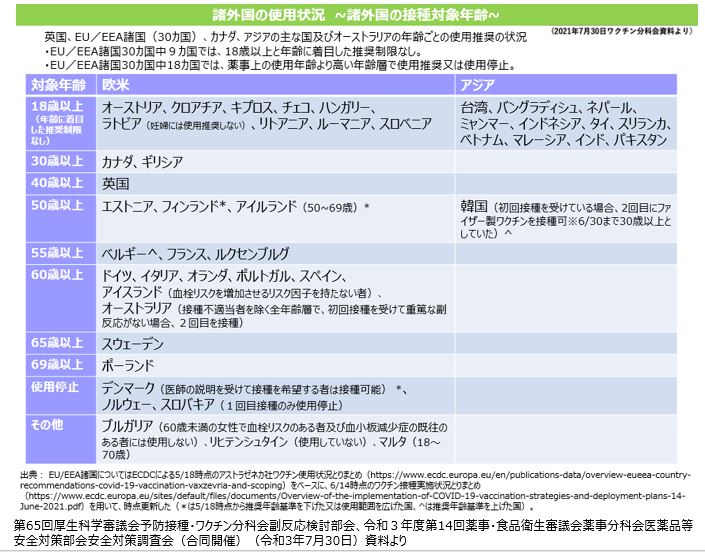
AstraZeneca vaccines are being used overseas with age restrictions. In Canada and Greece, people over 30 years old, in the UK over 40 years old, in France and Belgium over 55 years old, and in Germany, Italy, Spain, and the Netherlands over 60 years old. On the other hand, countries such as Austria, Croatia and the Czech Republic do not have age restrictions. Most of the Asian countries have no age limit, except for South Korea, where the minimum age is 50.
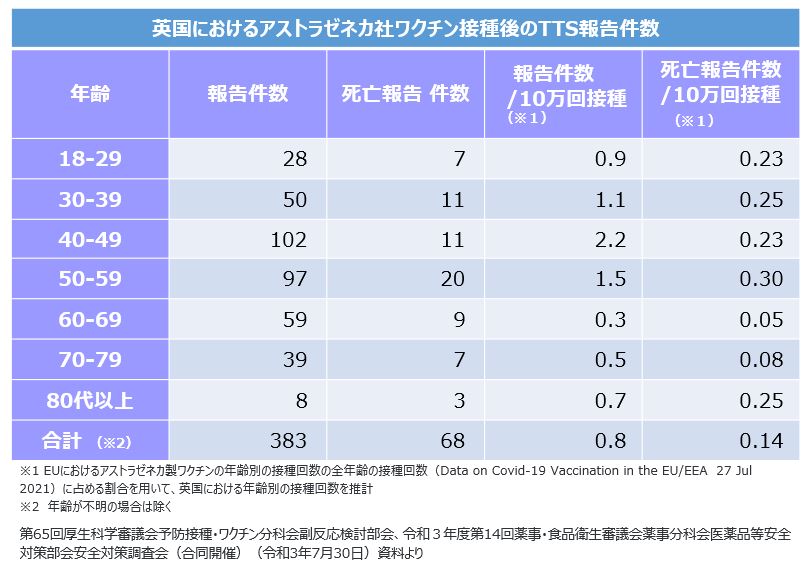
The reason why the age limit is set overseas is that symptoms suspected of TTS have been reported after vaccination, and they tend to occur more often in young people. Because the onset of blood clots is so rare, it is possible that the numbers only appeared after inoculating large numbers of people rather than in human trials. The number of TTS reported per 100,000 doses was 0.9 for those aged 18-29, 1.1 for those in their 30s, 2.2 for those in their 40s, 1.5 for those in their 50s, 0.3 for those in their 60s, 0.5 for those in their 70s, and 0.5 for those in their 80s. More than 0.7 cases. After the first dose, 14.8 cases per million doses and 1.9 cases per million after the second dose were reported.
A study from the University of Oxford found that a third dose of AstraZeneca's vaccine as a booster dose produced higher levels of antibodies than other vaccines, confirming protective efficacy. Those who received two doses of AstraZeneca vaccine followed by Pfizer vaccine had similar antibody levels to those who received two doses of Pfizer vaccine, but those who received two doses of Pfizer vaccine followed by AstraZeneca vaccine It is said that the antibody value was about 5 times higher than those who received two doses of AstraZeneca.



 URL copied
MEDIUS Group is developing a business centered on the sale of medical equipment. We (Medical + us) involved in medical care also want to play the role of an information source (Media) that delivers useful information for the medical field and people's healthy tomorrow.


The challenge of home medical care that "supports daily life" - A "triple win" for patients, medical institutions, and the government will ensure the future of an aging society...

Supporting the career advancement of female doctors Introduce career counseling to increase the number of female doctors aiming to become specialists...

The new value of medical care is to improve the happiness of patients and medical professionals by providing medical services that emphasize "emotional value"

Genomic medicine: the present and future expectations

Supporting regional medical care in disaster-prone Japan: Japan Medical Association Disaster Medical Team (JMAT)