Release date: 2026.02.27
"Smart medical devices" incorporating cutting-edge technologies such as sensors, AI (artificial intelligence), and IoT (Internet of Things) are making inroads into the medical world. While traditional medical devices simply measure and treat patients, smart medical devices enable continuous monitoring, automatic data collection and analysis, and information sharing with medical professionals, poised to dramatically change how we manage our health. In this first article, we will summarize the categories of smart medical devices and their use around the world.
Smart medical devices are a general term for devices that combine traditional medical equipment with digital technology to improve the efficiency of diagnosis, treatment, and monitoring. Their greatest feature is that they can be used not only for testing at hospitals, but also for continuous health checks from the comfort of your own home. They are increasingly being used in a wide range of situations, from the daily management of patients with chronic diseases to preventive medicine before illness even begins.
Many of these devices are linked to cloud and AI technology, enabling the accumulation, analysis, and sharing of data. Doctors can check patients' daily vital signs in real time, enabling remote consultations and rapid adjustments to treatment plans. Visualizing patients' own health status also has the effect of leading to improved lifestyle habits and increased motivation for treatment.
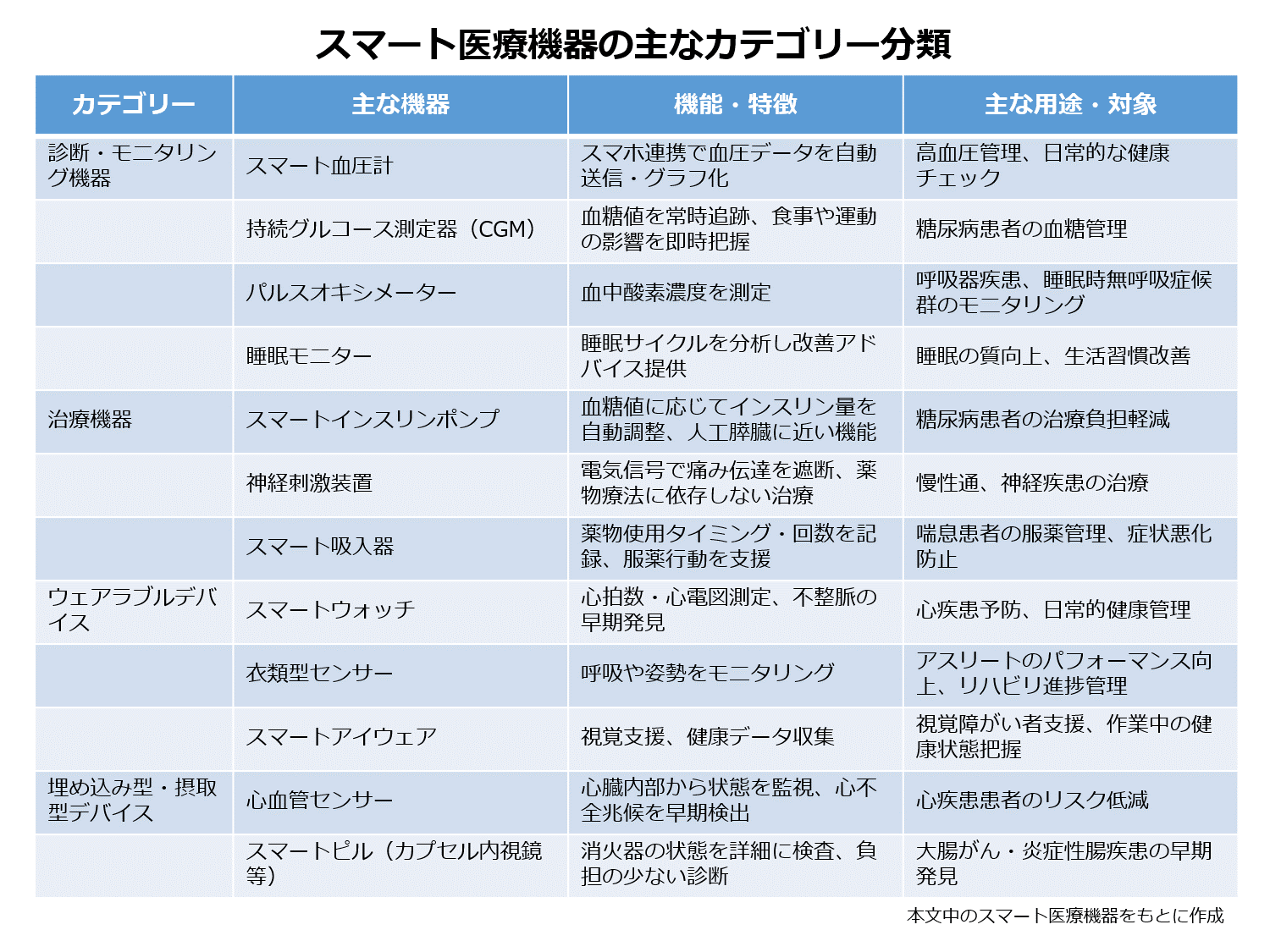
Smart medical devices can be divided into several categories based on their application and shape.
Diagnostic and monitoring devices are the most familiar category.
■Smart blood pressure monitor...It works in conjunction with a smartphone to record blood pressure, automatically sends the measurement data to an app, and graphs long-term trends.
■Blood glucose monitors...Blood glucose monitors such as continuous glucose monitors (CGMs), which constantly track fluctuations in blood glucose levels, are revolutionary tools that allow people with diabetes in particular to instantly understand the effects of their diet and exercise.
■Pulse oximeter...Measures blood oxygen levels and is useful for monitoring respiratory diseases and sleep apnea syndrome.
■Sleep monitor...Analyzes the depth of sleep and REM/non-REM sleep cycles, and provides specific advice to improve the quality of your sleep.
With the widespread use of these devices, precise data that was previously only available at medical institutions can now be easily obtained in everyday life. As health awareness increases, the importance of preventive medicine is being recognized once again.
The advancements in medical equipment have also been remarkable.
■Smart insulin pumps: Smart insulin pumps for diabetics automatically adjust the amount of insulin administered according to blood sugar levels. Some of the latest models offer functions similar to artificial pancreas, significantly reducing the burden on patients.
■Neurostimulators...Neurostimulators, which treat chronic pain and neurological disorders, block the transmission of pain using electrical signals, expanding treatment options that do not rely on drug therapy.
■Smart inhaler...Smart inhalers help asthma patients manage their medication by recording the timing and frequency of medication use and encouraging appropriate medication behavior, preventing symptoms from worsening.
These treatment devices also contribute significantly to the continued active treatment of patients in line with their treatment plans.
Wearable devices are a prime example of smart medical equipment.
■Smartwatches... Many smartwatches can measure heart rate. Some models can also measure electrocardiograms, which have been reported to be useful in the early detection of arrhythmias and the prevention of sudden death. Some models also have a blood pressure estimation function that uses optical sensors, which is expected to be useful in the early detection of high blood pressure.
■Clothing-type sensors...Sensors built into clothing monitor breathing and posture, and are used to improve athletes' performance and monitor rehabilitation progress.
■Smart eyewear...Research is being conducted into a variety of uses, such as providing visual assistance and collecting health data, supporting the daily lives of visually impaired people, and understanding their health status while at work.
The advantage of wearable devices is that they are so natural that you forget you are wearing them. Health management that blends seamlessly into everyday life is becoming a reality.
Even more advanced are devices that obtain information from deep inside the body.
■Cardiovascular sensor...Monitors the condition of the heart from the inside, detecting signs of heart failure early and reducing the risk of emergency hospitalization.
■Smart pills (capsule endoscopes, etc.) ...By swallowing these pills, the condition of the digestive tract can be examined in detail, and they are expected to become a less invasive diagnostic method that can replace conventional endoscopic examinations.They are expected to be applied to the evaluation of the entire digestive tract, with a focus on diagnosing small intestinal diseases.
Technologies that collect data directly from within the body enable more accurate and continuous monitoring, dramatically improving the precision of medical care. However, privacy and data security issues have also emerged, necessitating the development of new systems.
The use of smart medical devices is accelerating around the world.
In the United States, remote monitoring systems are being actively introduced in home healthcare as a means of reducing healthcare costs while improving patients' quality of life. In particular, there are an increasing number of cases where insurance is covering remote blood pressure and blood glucose monitoring for patients with chronic diseases, allowing patients to share data with their doctors in real time from the comfort of their own homes. This not only reduces the burden of hospital visits, but also enables medical institutions to provide more efficient medical care, ultimately leading to cost reductions for the healthcare system as a whole.
In Europe, emphasis is being placed on preventive medicine and the use of daily health management. Rather than treating illness after it has occurred, an approach that involves accumulating data while people are healthy and detecting disease risks early is becoming widespread. Systems for the integrated management of national health data have been established, primarily in Nordic countries, and data such as daily activity levels, heart rate, and sleep patterns obtained from smartwatches and fitness trackers is being used as the foundation for preventive medicine.
In Asia, smart medical devices are attracting increasing attention against the backdrop of rapidly aging societies. There are high hopes for them as a means of efficiently utilizing limited medical resources and supporting the health of the increasing elderly population.
Smart medical devices are transforming healthcare from something you receive to something you manage yourself. We are fast approaching a future where hospitals and homes are seamlessly connected, and doctors and patients can share data to enable more accurate diagnoses and treatments. As technology evolves, we are entering an era where each of us will be able to face our own health data and take the initiative in managing our own health.



 URL copied
MEDIUS Group is developing a business centered on the sale of medical equipment. We (Medical + us) involved in medical care also want to play the role of an information source (Media) that delivers useful information for the medical field and people's healthy tomorrow.


The challenge of home medical care that "supports daily life" - A "triple win" for patients, medical institutions, and the government will ensure the future of an aging society...
Supporting the career advancement of female doctors Introduce career counseling to increase the number of female doctors aiming to become specialists...

The new value of medical care is to improve the happiness of patients and medical professionals by providing medical services that emphasize "emotional value"

Genomic medicine: the present and future expectations

Supporting regional medical care in disaster-prone Japan: Japan Medical Association Disaster Medical Team (JMAT)