

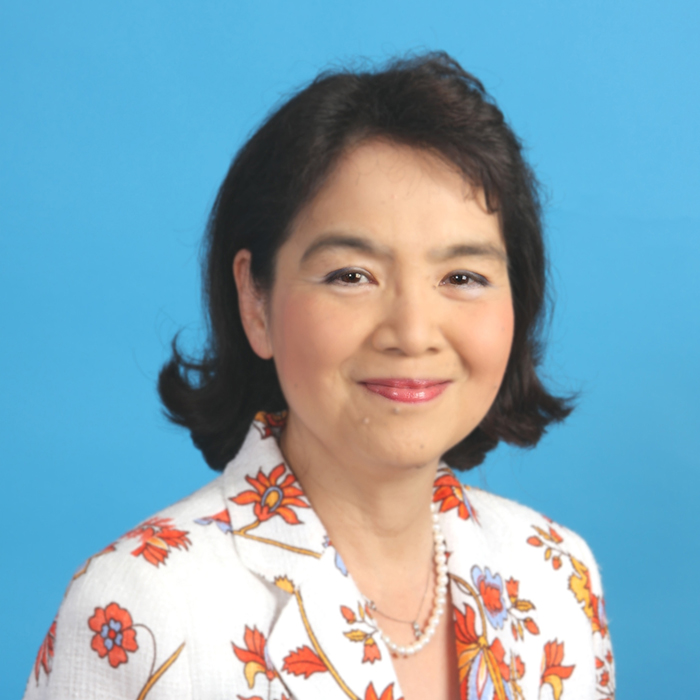
There was only one female doctor when she joined the department.
It has been 40 years since I started my career as a neurosurgeon. During this time, the environment surrounding neurosurgery has changed in various ways, but my way of life as a neurosurgeon, who constantly refines my skills and stays close to patients, to help patients suffering from illness has not changed.
After graduating from university in 1978, he became a neurosurgeon intern at Nagoya Health University (now Fujita Health University) in 1980. I chose neurosurgery because of the influence of my father who was a surgeon, but also because, unlike other surgeries, I was attracted to the fact that a single doctor could operate in a small space. I was the only woman who joined the department. At that time, there was Dr. Kimitoshi Sano, who was called "God's hand" in the Department of Brain Surgery, and I actively acquired the technique while receiving guidance from Dr. Sano and many seniors.
Neurosurgery involves a great deal of pressure because the patient's life is at stake, but my credo is to focus on the task at hand and never give up. Because the doctor's job is to heal the patient.
In addition to improving my surgical skills, I have always thought about what I can do as a doctor to see the smiles of my patients. Patients who have fallen ill are at the bottom of their minds and bodies. We have continued to heal our hearts by taking walks in the hospital garden and doing gymnastics together.
Creating a work environment that is conducive to women, both domestically and internationally.
In 1990, he established the Japan Neurological Surgery Women's Association and became the first chairman. At that time, there were less than 30 female neurosurgeons nationwide. There were problems such as the medical office not hiring women and the number of operations was small even after entering the hospital, so the first issue was to eliminate the difference between men and women.
I started to feel that it is strange that there is a difference in work content between men and women when I studied abroad in Suzhou, China in 1981. It is an era when many citizens in mao suits travel by bicycle. It was natural for all men and women to work, eat out, and raise children. Otherwise, the background was that households were suffering, but I witnessed the reality that there are no men or women in living a social life.
Currently, of the approximately 10,000 neurosurgeons in Japan, 6% are women, and 15% are in their 20s and 30s. The presence of female doctors is growing.
In 2008, he was also the founder of the "Fujita Health University Female Medical Students and Female Doctors Association". At that time, female doctors accounted for half of the residents in university hospitals. However, in reality, there were cases where it was difficult for female doctors to return to work after taking leave due to the lack of an environment in which they could work while giving birth and raising children. Therefore, as a place for female doctors to interact and increase their motivation beyond the boundaries of clinical departments, we have set up a nap room exclusively for female doctors and a tatami room where only women can relax.
Looking overseas, he was also involved in the establishment of the Asian Neurosurgery Women's Association in 1996. I have given lectures at various academic societies in participating countries, listened to their concerns on the spot, and gave advice. Educational support destinations have expanded, and more than 40 countries have visited in 25 years. In 2019, we visited 13 countries 24 times, mainly in Asia such as India, Indonesia, Vietnam and Uzbekistan. Due to the spread of the new coronavirus infection, communication is now on the Internet, but we are discussing the ideal way of brain surgery education and the effective use of medical resources.
Advances in surgical equipment have improved surgical safety.
One of the changes in the environment surrounding neurosurgery is the advancement of medical equipment. For example, clipping surgery for an unruptured aneurysm used to take more than 6 hours, but now it becomes a problem when it takes so long. By slimming down the equipment and navigating to the hump in a dark, narrow and distant place, it is now possible to reach the hump by the shortest route possible while avoiding barriers such as blood vessels. As a result, it has become possible to perform surgery in a short time with minimal invasiveness, and the treatment results have greatly improved.
Especially in the operation of brain tumors by neuroendoscopy, the degree of invasiveness became so low that the patient could move the next day. Because the light source is bright, it is possible to safely approach the aneurysm, and the resolution of the endoscope can be increased to take close-up shots just before the aneurysm, making it possible to perform safe and accurate surgery.
On the one hand, these advances in medical equipment in the field of neurosurgery are accompanied by rising prices for equipment and materials. We always keep in mind that a well-planned surgery plan will have the greatest effect on the patient while minimizing costs.
Because their work is so demanding, healthcare workers need rest.
I think every medical professional is always hard work. This is probably the fate of not only doctors, but also nurses, comedics, and other people who choose to follow the medical path. However, if you are exhausted by it, you will not have any children. Medical professionals are the ones who are close to patients who are worried about their illness and who are energized. I think it's important for you to be healthy at all times.
To do this, you need to have enough rest. I think each person has different ways of resting and what to do in the meantime, but for example, no matter how busy I am, if I feel tired both physically and mentally, take a 10-15 minute break. I am doing it. I am a medical professional because I want to save the lives of patients and see smiles, what I became a doctor for, not only to heal my physical fatigue but also to regain my feelings. I try to return to the starting point of what is the food of my heart. By taking such a rest, I think that the tension will be restored.
Medical professionals who are already busy are getting even busier due to the effects of the new coronavirus. I think it is important to consciously switch on and off because of the "no rest" situation.
We value providing compassionate care to our patients.
Due to the effects of the new coronavirus, the number of outpatients is decreasing. Unfortunately, there are some patients who cannot meet in person during follow-up and postoperative follow-up, so we cover them by telephone medical treatment and confirm that there is no deterioration in QOL. A letter sent by a patient said, "Everyone in the hospital may be infected with the coronavirus." Communication by telephone is important to resolve such misunderstandings and alleviate excessive fear. I also try to convey a message that makes me feel soothed, like when I took a walk in the hospital garden with a patient.
Related Links
- The increasing number of elderly people requiring emergency transport and the challenges involved, as well as the current state of confirming the wishes of the individual and their family, and providing individualized care.
- Will wearable devices, which play an active role in the medical and nursing care industries, become essential items that support the extension of healthy life expectancy?