Efficiency became an issue in the wake of hospital reform.
Focus on task shift to AI
Since 2014, when I was appointed hospital director, our hospital has carried out bold hospital reforms with the aim of becoming a community-based medical facility. As we have made a major shift from a general hospital to an advanced acute care hospital specializing in specific medical care, we have strengthened our collaboration with local medical institutions. Alliance Hospital, which has now expanded to 17 facilities, covers the entire Miura Peninsula, and our hospital accepts approximately 60% of acute-stage inpatients on this peninsula. Additionally, in fiscal 2021, the number of emergency transport cases will exceed 11,000 per year, ranking second in the country.
Along with these changes, increasing efficiency and improving quality in the medical field has become an even more important issue, and we focused on task shifting to AI as a trump card. In March 2018, we independently developed an AI hospital with the aim of improving the quality of medical care and increasing patient satisfaction by reducing the workload of medical personnel and allowing them to concentrate on highly specialized tasks. I embarked on
At our hospital, this was an inevitable trend. In the medical world, which suffers from a chronic shortage of manpower, I think all medical institutions will be forced to tackle medical DX, but medical DX is just one tool for improving efficiency and quality. . The first thing to do is to establish the direction of your hospital, and then you should introduce it. Otherwise, we will not know what we really need, and we will not be able to incorporate and utilize AI technology that is useful in clinical practice.
Best in digital understanding
Appointment of young employees is the driving force for DX
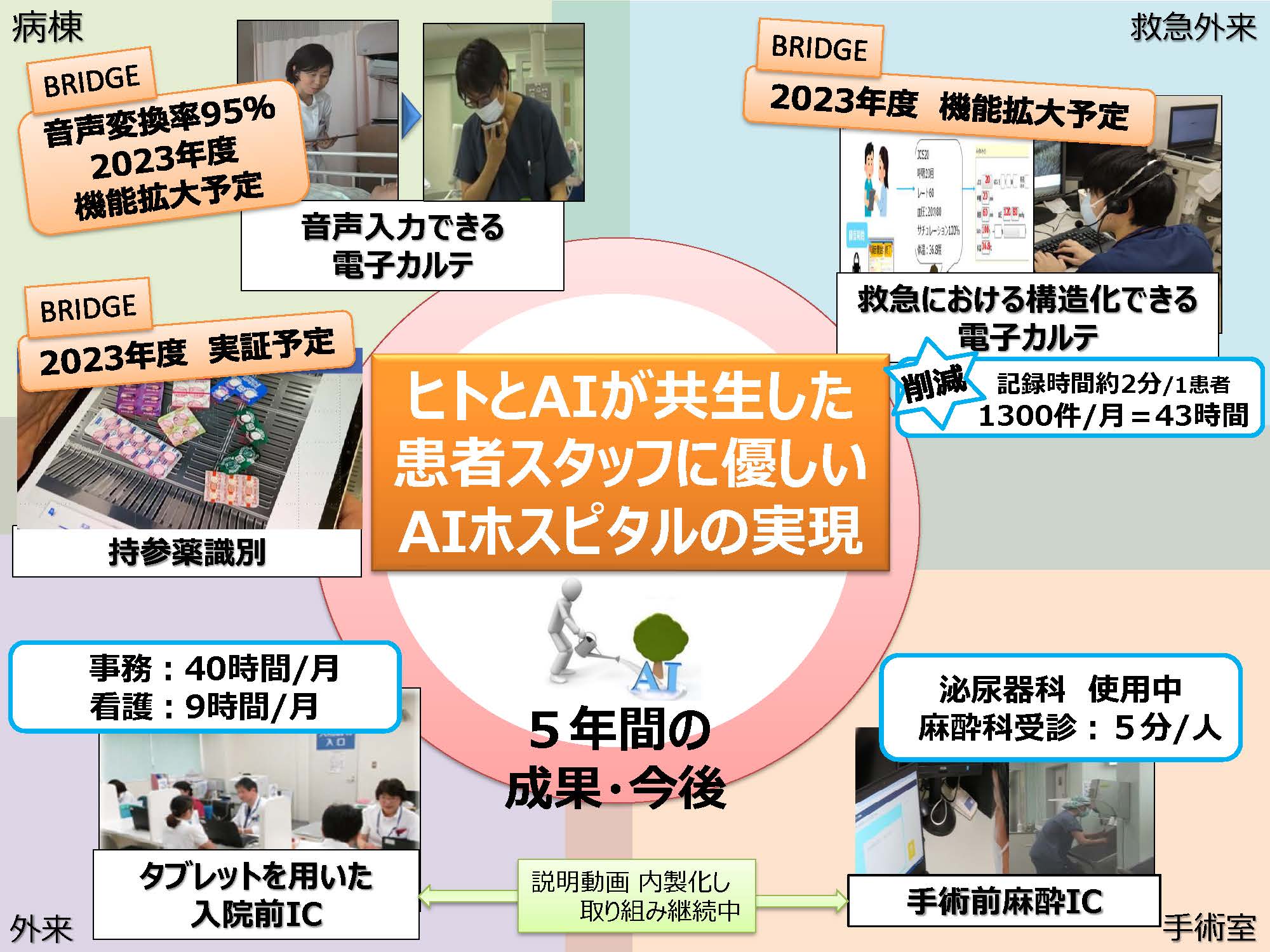
Our hospital, which has also participated in the Cabinet Office's SIP (*), has five projects in progress toward development and implementation (as of October 2013). We are actively utilizing AI technology in various clinical situations within the hospital, and are steadily achieving results with a focus on improving efficiency, such as shortening work hours (see diagram).
When developing (or introducing) AI technology at your own hospital, it is important to first understand what is needed in the medical field. We believe that it will be easier to tackle routine tasks that are burdensome through a workload survey, and prioritize the use of AI in those areas. When developing (or selecting) technology, we keep three things in mind: ease of use, cost, and results. In order for a product to be used in the field, it is most important that medical professionals feel it benefits them. Therefore, our hospital holds an AI conference in which each department participates and brainstorms ideas. For example, the ``Medication Identification'' project, for which demonstration experiments have begun this year, was initiated by the Department of Pharmacy. Furthermore, we continue to make improvements to AI technologies developed in other projects, with an emphasis on practicality in the field, while incorporating user feedback.
On the other hand, "digital understanding" is essential to promoting medical DX. The people who are best at this point are young employees called ``digital natives.'' Going forward, there will be a strong need for management to be aware that they are weak in digital technology, and to demonstrate their management skills by entrusting the medical DX transformation to young employees and taking on the final responsibility. I think it will come.
Our hospital, which advocates community-based medical care, is considering actively working on DX of medical care not only within the hospital but also in the region, and in fiscal 2014, we are planning to create a digital network with alliance hospitals. Masu. In this plan, as well as within the hospital, we have repeated fundamental discussions with the participating alliance hospitals, such as ``What do we want to do, and what kind of AI technology can we use to achieve this?'' We would like to introduce AI technology that is useful for local medical care and promote medical DX.
*SIP: Abbreviation for “Strategic Innovation Creation Program” implemented by the Cabinet Office. Among these, the theme of ``Advanced diagnosis and treatment system using AI hospital'' was set, and the research theme that Yokosuka Kyosai Hospital applied for together with the National Center for Child Health and Development and four other hospitals was selected.
(Figure) Overall picture of the AI hospital project being undertaken by Yokosuka Mutual Aid Hospital