
Corporate Governance Guidelines
Purpose of this guideline
This guideline aims to fulfill our social responsibility to all stakeholders, including shareholders, customers, local communities, business partners, and employees, and to achieve sustainable growth and enhance corporate value for MEDIUS Group (hereinafter referred to as "the Company" or "the Company Group") by establishing fundamental matters concerning corporate governance within the Company Group.
1. Basic idea
Under our management philosophy of "contributing to regional healthcare," our group aims to achieve sustainable growth and enhance corporate value through honest and fair business activities, while also contributing to the sustainable development of society. We believe that establishing a corporate governance system is crucial for achieving this, and we will play a proactive role in the management of our group, striving to thoroughly implement corporate governance through formulating group strategies and policies, providing guidance and advice to each group company, and compiling important matters.
2. Overview of corporate governance system
Overview of our group’s corporate governance system
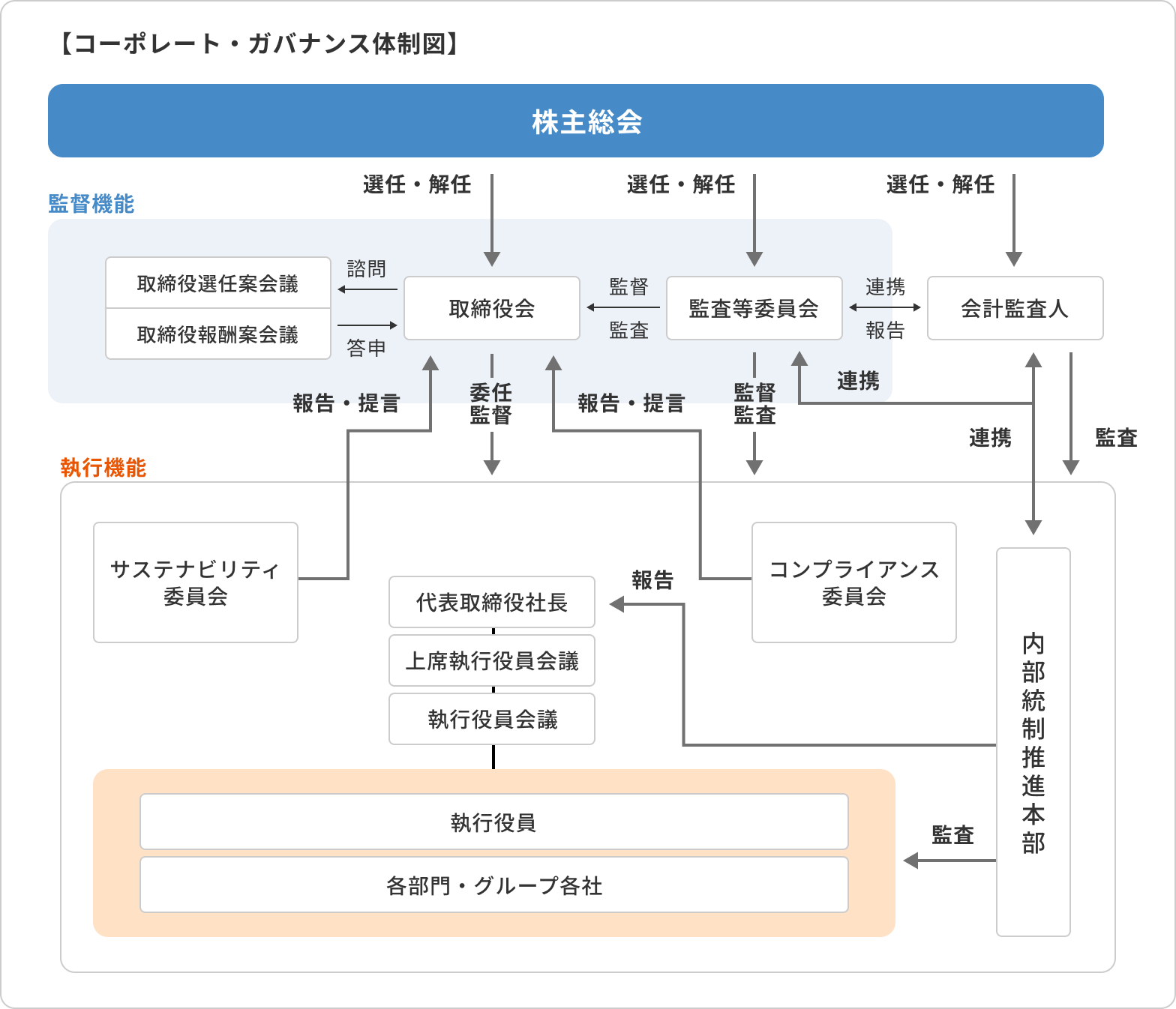
Aiming to further enhance our corporate governance, we have adopted a structure that includes an audit and supervisory committee, which clarifies executive responsibility and streamlines decision-making through the delegation of authority, while also further strengthening the supervisory function of the board of directors.
3. Roles of the Board of Directors and Directors, etc.
The Board of Directors makes decisions on important matters of the Group, including matters stipulated by laws and regulations and the Articles of Incorporation, as well as discussions on management strategies, medium- to long-term plans, and management challenges, and supervises the execution of duties by the Directors. Furthermore, in order to expedite and streamline decision-making, the decision-making authority for business execution will be delegated to the Representative Director and Executive Directors to the greatest extent possible. The aim is to realize management strategies and achieve target management indicators in an efficient, sound, and transparent manner. In addition, in order to ensure the proper conduct of the Group's operations, the Board of Directors will establish a "Basic Policy on Internal Control Systems" based on the Companies Act and its implementing regulations, and will build and operate an internal control system based on this policy. Moreover, in order to further strengthen the supervisory function of the Board of Directors, more than one-third of the members will be independent outside directors.
4. Operating structure of the board of directors, etc.
Our company strives to provide directors with appropriate and necessary information so that they can effectively fulfill their roles and responsibilities. Furthermore, at board meetings, we distribute relevant materials to attendees in advance and, if necessary, provide prior explanations to outside directors to enable constructive discussions and exchanges of opinions. The board of directors analyzes and evaluates its effectiveness annually, discloses the evaluation results, and works on measures to further improve its function based on these results.
5. Role of the Audit and Supervisory Committee, etc.
The Audit and Supervisory Committee, acting independently, audits the performance of duties by the Board of Directors, Directors, and Executive Officers, decides on proposals to be submitted to General Shareholders Meeting of Shareholders regarding the appointment, dismissal, and non-reappointment of accounting auditors, and carries out matters stipulated by law, such as accounting audits. The Audit and Supervisory Committee conducts audits under the mandate of the shareholders, and its members include full-time Audit and Supervisory Committee members who are well-versed in the Company's business, and part-time Audit and Supervisory Committee members who possess appropriate knowledge of company management, finance and accounting, law, etc. Full-time Audit and Supervisory Committee members gather information from Directors, the Internal Audit Department, and other employees through attendance at important internal meetings, visits to various departments of the Company Group, dialogues, and review of important resolution materials, and share this information in consultations with the Audit and Supervisory Committee and the auditors of each group company, striving to improve the audit environment within the Company Group. In addition, necessary support staff will be appointed to ensure that the Audit and Supervisory Committee performs its duties appropriately and effectively. The independence of these support staff will be guaranteed.
6. Internal control
(1) Internal control system
The Board of Directors establishes basic policies for the internal control system, builds systems for compliance, risk management, ensuring the reliability of financial reporting, etc., and supervises the operational status of these systems by utilizing the internal audit department and others. The Compliance Committee, chaired by the representative director, and the Risk Committee, which is a specialized subcommittee of the Sustainability Committee, have been established to deliberate important matters related to compliance and consider risks, and to share their findings with the Board of Directors and the Audit and Supervisory Committee. I will report that.
(2) Internal Control Promotion Headquarters
① Internal Audit Office
We consider the internal audit department, including those of group companies, to be important, and have established an internal audit office and assigned human resources to play this important role. Based on the annual internal audit plan, the Internal Audit Office conducts audits regarding internal controls and compliance status from the viewpoint of legality, appropriateness, efficiency, etc. of the business execution status of each division of the Group. . The audit results, etc. are reported directly to the Board of Directors and the Audit and Supervisory Committee, in addition to being reported to President and CEO Medius Holdings Co., Ltd. and president on the business execution line.
② Legal Compliance Promotion Department
Our company will establish a Legal and Compliance Promotion Department with the aim of providing legal support to the entire group and promoting and strengthening compliance systems. The Legal and Compliance Promotion Department will be staffed with personnel well-versed in laws and regulations, including in-house lawyers, and will work in cooperation with each group company to develop systems for ethical and legal compliance and support each company in ensuring their proper implementation.
7. Accounting Auditor
Our company ensures sufficient audit time to enable the independence and high quality of the external auditor, and provides a forum for regular exchange of opinions with our Representative Director. In addition, the Director in charge of Finance will consult with the external auditor as needed to deepen mutual understanding. Furthermore, regular forums for exchange of opinions and discussions will be held between the external auditor, the Audit and Supervisory Committee, and the Internal Audit Department. The Audit and Supervisory Committee will receive reports on the activities of the external auditor each period, and will exchange opinions with the Representative Director and the Director in charge of Finance to evaluate the appropriateness of the external auditor's audit quality and remuneration level, as well as confirm their independence and expertise.
8. Cooperation among the Audit and Supervisory Committee, Accounting Auditor, Internal Audit Office, and Legal Compliance Promotion Department
The Audit and Supervisory Committee and the Accounting Auditor regularly exchange opinions in order to make the corporate governance of the Group more appropriate. The Audit and Supervisory Committee regularly receives reports from the Internal Audit Office and the Legal Compliance Promotion Department regarding audit plans, internal audit results of each department and subsidiary, other audit-related matters, and the status of compliance promotion. In addition, as necessary, the full-time Audit and Supervisory Committee members, internal audit staff, and compliance promotion staff will hold meetings to share information and work together.
9. Nomination, remuneration, etc. of officers
The Board of Directors' Nomination Committee (a voluntary nominating committee) and the Board of Directors' Compensation Committee (a voluntary compensation committee), which are advisory bodies to the Board of Directors, are composed of outside directors who are audit and supervisory committee members, the Representative Director, and the Director in charge of Human Resources, with the Representative Director serving as chairperson. The Board of Directors' Nomination Committee deliberates on nominated candidates for the Company's directors (excluding directors who are audit and supervisory committee members) and officers of each of the Company's group companies, and recommends officer candidates to the Board of Directors. When deliberating on nominated officer candidates, the Board of Directors' Nomination Committee considers the following elements: Qualifications and abilities of the officer: Possessing the qualities to appropriately fulfill the duty of care and loyalty in the execution of duties and to contribute to the Company's sustainable profit growth and enhancement of corporate value. For executive officers, possessing familiarity with the Company Group's business and the ability to appropriately manage the Company Group. When the Company proposes officer candidates at General Shareholders Meeting, it will explain the reasons for the nomination of such candidates in the notice of convocation. At the Directors' Compensation Proposal Meeting, the level and indicators of compensation for directors (excluding directors who are audit and supervisory committee members) will be considered, and the appropriate amount of compensation for directors will be deliberated and reported to the Board of Directors. Compensation for directors (excluding directors who are audit and supervisory committee members and outside directors) will consist of base salary (fixed salary), bonuses (short-term incentive compensation), and stock compensation (medium- to long-term incentive compensation). The level of compensation and individual compensation for such directors will be determined by a resolution of the Board of Directors within the scope of the compensation framework resolved at the General General Shareholders Meeting. In light of their role in overseeing the management of the Company from an objective and independent standpoint, outside directors (excluding directors who are audit and supervisory committee members) will only receive base salary (fixed salary). In light of their role in overseeing and auditing management, directors who are audit and supervisory committee members will only receive base salary (fixed salary). Individual compensation for directors who are audit and supervisory committee members will be determined by consultation among the audit and supervisory committee members within the scope of the compensation framework resolved at General Shareholders Meeting of Shareholders. The level of compensation for all directors will be determined in accordance with their responsibilities, etc., using objective compensation survey data from external expert organizations. Furthermore, the Audit and Supervisory Committee members participating in the advisory body will report to the Audit and Supervisory Committee on the status of the appointment and compensation determination process for directors (excluding directors who are Audit and Supervisory Committee members), and the committee will deliberate on its appropriateness. The Audit and Supervisory Committee will exercise its right to express its opinion to General Shareholders Meeting when necessary.
10. Officer training policy
When new directors are appointed, we will provide them with training on the Companies Act and other related laws and regulations, compliance, management strategy, finance, etc., as necessary, and we will continue to provide training on these topics as necessary after they take office, and strengthen our efforts to resolve management issues. as the foundation of In addition, outside directors will be given an overview of the Group's business and tours of major locations as necessary.
11. Outside Director
We have determined that all of our outside directors are independent and have registered this with the Tokyo Stock Exchange. We recognize the usefulness of outside directors and believe that they contribute to the enhancement of corporate governance by stimulating discussions in the Board of Directors through their questions and opinions, and by enabling appropriate decision-making and oversight through the presentation of diverse perspectives from outside directors. We believe that appointing independent outside directors with more diverse expertise and experience will further stimulate discussions in decision-making and oversight bodies, including the Board of Directors, and ensure appropriate decision-making and oversight. Therefore, we will continue to appoint suitable individuals with the background, experience, and knowledge to enhance our corporate governance as independent outside directors.
The independence of outside directors is determined based on the following criteria:
- ① Business executive of our company or our affiliated companies (work experience within the past 10 years) (*1)
- ②A person whose main business partner is our group, or a business executive thereof (*2)
- ③Major business partners of our group or their business executives (*3)
- ④A major shareholder of the Company (a person who directly or indirectly holds voting rights of 10% or more of the total voting rights) or a business executive thereof
- ⑤A person or a business executive of a person in which our group directly or indirectly holds 10% or more of the total voting rights.
- ⑥A person affiliated with an auditing corporation that is the accounting auditor of our group
- ⑦ Lawyers, certified public accountants, tax accountants, consultants, etc. (*4) who receive large amounts of money or other financial benefits from our group in addition to executive compensation.
- ⑧A person who belongs to a corporation such as a law firm, auditing corporation, tax accountant corporation, or consulting firm, or an organization such as an association that receives a large amount of money or other property benefits from our group (*4)
- ⑨A person who receives large donations or subsidies from our group, or a director or other business executive of an organization such as a corporation or association (*4)
- ⑩In cases where a full-time director of our group concurrently serves as an outside officer of another company, a person who is an executive director, executive officer, or other employee of that other company.
- ⑪Persons who have fallen under ② to ⑩ above within the past three years.
- ⑫ If the person falling under ① to ⑩ above is an important person, that person's spouse or relative within the second degree of kinship (*5)
*1. "Executive officers" refers to directors, executive officers, employees who execute business, trustees, and other persons equivalent thereto, as well as employees of a corporation or other organization.
*2. Business partners whose payments from our company exceed 2% of their consolidated sales or 100 million yen, whichever is higher.
*3. Business partners whose payments to our company exceed 2% of our consolidated sales or 100 million yen, whichever is higher.
*4. A large amount means an average of 10 million yen or more per year for individuals over the past three fiscal years, or more than 2% of the consolidated sales or total revenue of a corporation, association, or other organization over the past three fiscal years.
*5. Important persons refer to officers, executive officers, and employees in senior management positions at the department head level or higher.
12. Code of Conduct
In order to promote lawful and fair business activities, our group has established compliance guidelines that all directors, executive officers, and employees must abide by, and we are working to ensure that these guidelines are fully disseminated. Our company will regularly share and confirm information at the Board of Directors and Compliance Committee regarding the status of compliance with these compliance guidelines.
13. Timely, appropriate and fair information disclosure
The Company will disclose financial information such as the financial condition and Results of Operations of the Group, as well as non-financial information such as information related to management strategies / issues, risks and governance, in a timely, appropriate and fair manner in accordance with laws and regulations. , We will take the initiative in providing information other than disclosure based on laws and regulations.
14. Dividend policy
We will strive to return profits to shareholders in a manner that comprehensively considers our performance and future funding needs, while securing the internal reserves necessary to strengthen our management foundation and expand our business over the medium to long term. We aim for stable dividend increases driven by profit growth, with a consolidated dividend payout ratio of 30% or more as a guideline, and in the medium to long term, we will also consider improving the dividend payout ratio depending on funding needs and profit growth.
15.General General Shareholders Meeting
Recognizing that General Shareholders Meeting is our highest decision-making body and an important forum for constructive dialogue with shareholders, our basic policy is to explain the status of our business and the issues we must address to shareholders, and to allow for thorough discussion, including question-and-answer sessions, before they vote on the agenda items, so that the will of shareholders is appropriately reflected in our management. Furthermore, in order to contribute to our sustainable growth and the improvement of our corporate value in the medium to long term, we will also establish a system for constructive dialogue with shareholders outside of General Shareholders Meeting. To ensure that shareholders have sufficient time to consider the agenda items before the meeting, we will endeavor to send out the notice of convocation early and will also disclose the contents of the notice on our website before sending it out.
16. Securing the rights of shareholders
Our company will create an environment that allows shareholders to exercise their rights in order to ensure that their rights are protected. The protection of shareholders' voting rights is as described in "15. General Shareholders Meeting". If a resolution is passed at General Shareholders Meeting but it is determined that there were a significant number of dissenting votes, the Board of Directors will conduct an analysis of the causes and, if necessary, disclose the results of that analysis to shareholders. If our company proposes to General Shareholders Meeting that some of the matters to be resolved at the shareholders' meeting be delegated to General Shareholders Meeting, the Board of Directors will seriously discuss whether our company has the appropriate structure to support such a proposal. Our company will ensure equality among shareholders and give due consideration to minority shareholders, and will give full consideration to the exercise of the rights granted to minority shareholders.
17. Dialogue with shareholders
At our company, we believe that constructive dialogue with shareholders contributes to our sustainable growth and the enhancement of our corporate value in the medium to long term. Therefore, President and CEO Medius Holdings Co., Ltd. is designated as the IR officer, and the President himself engages in dialogue, while the IR Department is responsible for supporting these dialogues. In addition to disclosing information on our website, we hold Financial Results twice a year, as well as regular small meetings and briefings for individual investors. The IR officer communicates the group's perspective to shareholders and investors through dialogue, and provides feedback on opinions and requests received from shareholders and investors to the directors, management executives, and outside directors to ensure a shared understanding of the issues. The IR department, in addition to daily information sharing with various departments within the company, creates easy-to-understand disclosures such as financial results and IR materials using graphs and charts, and supports dialogue with all stakeholders, including shareholders and investors. As a general rule, we conduct a beneficial shareholder survey once a year to understand our shareholder structure.
18. Shares held by the Group
Our company will strategically hold shares in business partners or competitors when it is possible to maintain or develop long-term business relationships through such holdings, or when it is deemed to have strategic importance, such as for expanding the scale of our business. Furthermore, the rationality of holding each individual strategically held share will be reviewed periodically by the Board of Directors, and any holdings whose significance has diminished will be reduced. Regarding the exercise of voting rights for strategically held shares, we will carefully examine the content of the proposal and exercise the voting rights appropriately after determining whether or not it will contribute to improving shareholder value. We will not make a positive decision on proposals that would impair shareholder value, regardless of whether they are proposed by the company or by shareholders.
19. Policy on transactions between related parties
In principle, we will not engage in related-party transactions within our group. However, if a transaction is unavoidable, we will take into account the need to ensure independence and will make a decision only after thorough deliberation by the Board of Directors, which includes several independent outside directors, regarding the appropriateness of the transaction terms and the method of determining them. In addition to the above prior deliberation, at the end of each fiscal year, we will obtain confirmation letters from the directors and audit committee members, and in conjunction with this, the management department will conduct a post-transaction check by reviewing accounting records, etc., to ensure that the transaction is conducted in accordance with the content of the deliberation.
20. Supplementary provisions
The establishment, revision, or repeal of these guidelines shall be decided by resolution of the Board of Directors.
Established on September 25, 2015
Revised August 9, 2016
Revised December 19, 2018
Revised December 19, 2019
Revised on August 29, 2022 (the revision of the total executive compensation limit came into effect on September 29 of the same year).
Revised September 28, 2023
Revised September 29, 2026